

The Ministry of Labour (MoL) is cracking down on fake employment, warning private sector companies that they face a RO500 fine if they fail to replace Omani workers who leave after their recruitment has helped them qualify for Omanisation incentives.
The measure targets companies that recruit Omanis primarily to meet prescribed Omanisation percentages, benefit from reduced labour fees and subsequently terminate their employment, without providing them with genuine jobs or meaningful work experience.
Ammar bin Salim Al Saadi, Director General of Labour and Spokesperson for Labour Affairs at the ministry, said the penalty forms part of a gradual enforcement process designed to give companies sufficient time to fill vacancies before financial sanctions are imposed.
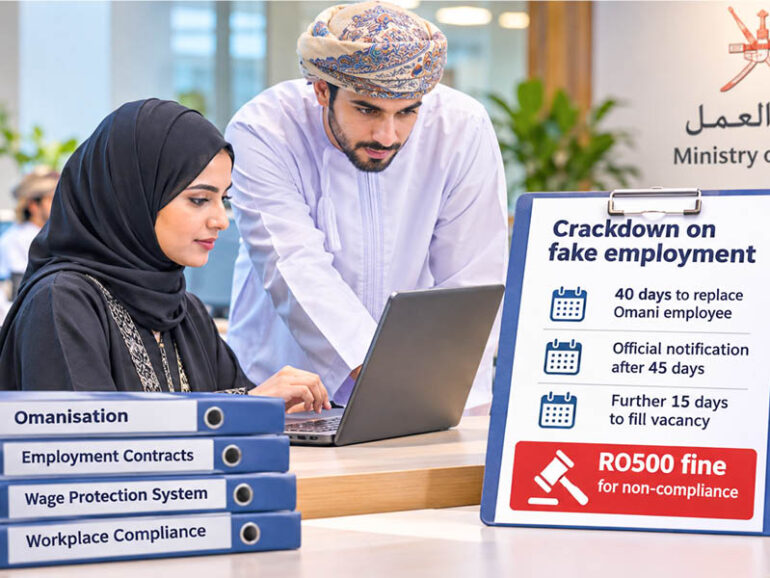
Under the procedure, companies have 40 days to replace an Omani employee after a worker leaves. If they fail to do so, the ministry issues an official notification after 45 days, allowing a further 15 days to fill the vacancy. Companies that fail to comply within the stipulated period face a RO500 fine.
Al Saadi stressed that the measure was not intended to penalise businesses generally, but to address practices in which recruitment is used merely to satisfy Omanisation requirements and secure financial advantages.
“We do not want companies to recruit employees merely to achieve Omanisation percentages and then dismiss them after three days,” he said, emphasising that the ministry’s priority was job stability and genuine employment.
He estimated that around 5% to 10% of companies engage in such practices, while the vast majority comply with labour regulations.
The ministry wants to move beyond measuring employment through recruitment numbers and salary payments, placing greater emphasis on whether Omani employees actually perform their jobs, develop professional skills and contribute to workplace productivity.
Al Saadi identified three essential elements of genuine employment: a real job opportunity, clearly defined responsibilities and tasks, and measurable productivity that benefits both the employer and employee.
He warned that fake employment arrangements deprive young Omanis of valuable workplace experience and undermine their ability to develop skills and progress in their careers.
“The labour market needs experience. If an employee joins an establishment without duties or responsibilities, how will that person develop skills and gain experience?” he asked.
The MoL is improving its monitoring mechanisms through the Wage Protection System, which enables it to track salary transfers and compare actual payments with the amounts specified in employment contracts.
Repeated discrepancies, particularly when salaries transferred are consistently lower than contractual amounts, can raise concerns and prompt further investigation.
The ministry also monitors patterns of repeated resignations and employment terminations shortly after recruitment, which may indicate attempts to manipulate Omanisation figures.
However, Al Saadi emphasised that suspected violations must be examined individually, taking into account the nature of the work. Field-based, part-time, remote and freelance jobs, for example, may not require employees to report regularly to company premises.